Loading...
A Guide to the EIB Complaints Mechanism (EIB-CM)
If the European Investment Bank Group (EIB Group) has financed a project that is causing harm to you, your community, or the environment, you may be able to file a complaint with their accountability mechanism, the Complaints Mechanism (EIB-CM). You can also complain to the EIB-CM if the EIB Group has refused to share information with you.
What is the EIB?
The European Investment Bank Group (EIB Group) is the lending arm of the European Union (EU), established in 1958 by the Treaty of Rome. It is headquartered in Luxembourg. It consists of two main entities: the European Investment Bank (EIB) and the European Investment Fund (EIF) (together, the EIB Group). Together, they work to support the EU’s economic, social and environmental objectives through various financial products and services.
The European Investment Bank (EIB) is one of the world’s largest development banks. The EIB is the main lending arm of the EU, providing long-term loans for projects that support EU policy goals. The EIB focuses on large-scale projects and infrastructure development, and also invests in Europe’s security and defense industries. Clients of the EIB are primarily large corporations, public sector entities, and other financial institutions. Around 10% of EIB’s funds go towards projects located outside of the EU.
The European Investment Fund (EIF) specializes in supporting Europe’s micro, small, and medium-sized enterprises (SMEs) by enhancing their access to finance. It provides risk finance to benefit SMEs and mid-caps across Europe, primarily through venture capital and private equity, as well as guarantees and microfinance. Clients of the EIF are primarily financial intermediaries, such as banks, guarantee institutions, and venture capital funds, which then on-lend or invest in SMEs.
What is the Complaints Mechanism?
The EIB-CM was established in 2008. Since 1 October 2026, it has a new Complaints Mechanism Policy which has made some significant changes to how it does its job. Under the 2026 Policy, the EIB-CM handles two types of complaints:
- Environmental and social complaints: about negative impacts on people or the environment caused, or likely to be caused, by a project the EIB Group is financing.
- Access to information complaints: about the EIB Group refusing or failing to share information or documents.
Other complaints about poor administration by the EIB Group (for example, unfair treatment or policy violations that are not linked to a specific project) are no longer handled by the EIB-CM. You can take these concerns to the European Ombudsman.
If your complaint is accepted, the EIB-CM will decide how to handle it, taking into account your preferences. There are three possible paths:
- Early resolution: for simple issues that can be fixed quickly, EIB staff will try to solve the problem without a full complaint process. This only happens if you agree, and is limited to six months (for environmental and social complaints) or two months (for access to information complaints). You may exit the process and return to the EIB-CM at any time if you feel that no progress is being made.
- Dispute resolution (for environmental and social complaints only): the EIB-CM will attempt to bring you and the company or public body carrying out the project (and potentially bank staff) together to try to reach a mutually agreeable solution to your concerns. Because engaging in dispute resolution is entirely voluntary, any party may terminate the process at any time.
- Compliance review: the EIB-CM will conduct an investigation into whether the EIB Group and the project followed the EIB Group's own rules. The investigation will result in a public-facing report and possible commitments to remedy harm.
If dispute resolution does not solve all your concerns, the remaining issues can move to compliance review, if you agree. You can learn more about these paths in the sections below, and on the homepage of this guide.
Please note that, for complaints filed before 1 October 2026, the process is different. Your complaint follows the 2018 EIB-CM Policy and Procedures. We have archived our previous version of this guide, which explains how the EIB-CM handles complaints filed before 1 October 2026.
Dispute Resolution
The EIB-CM's voluntary Dispute Resolution process aims to resolve environmental and social complaints (only) collaboratively to improve the situation on the ground. The EIB-CM brings together you and the project promoter (the company or public body carrying out the project), and helps you talk, negotiate, share information or gather facts together. EIB Group staff may also take part.
Dispute Resolution is a flexible process and depends on the willingness of all parties to participate. If an agreement is reached, the EIB-CM will formalize it and monitor its implementation. If no agreement is reached, the complaint can proceed to Compliance Review, if you agree.
You can learn more about this phase below.
Compliance Review
The Compliance Review process, also referred to as “investigation,” focuses on whether the EIB Group complied with its environmental and social and transparency standards, and whether any failures have caused or could cause harm to you.
The findings are compiled in a Conclusions Report, which may include recommendations to address any non-compliance and to remedy any harm caused.
EIB Group staff must then prepare an action plan for environmental and social complaints, or, for access to information complaints, explain any recommendations they will not carry out. If there are concerns about the actions to be taken, senior leaders of EIB (the EIB’s Management Committee or the EIF’s Chief Executive/Deputy Chief Executive) must respond, and the EIB-CM reports on this disagreement to the EIB Group’s Boards. The EIB-CM then monitors whether the plan is carried out.
You can learn more about this phase below.
Can you complain to the EIB-CM?
Before filing a complaint, ask yourself the following questions. If your answer is yes to all of the questions, then you can complain to the EIB-CM.
You can file two types of complaints to the EIB-CM.
Environmental and social complaints: First, you can file a complaint if you believe an EIB Group project is causing, or is likely to cause, environmental or social harm. For example: pollution, damage to land, water or forests, loss of homes or livelihoods, health and safety risks, harm to Indigenous Peoples, labour rights abuses, or lack of proper consultation. You do not need to prove that the EIB Group broke its environmental and social rules to file a complaint. But explaining which rules you think were not followed can strengthen your complaint (see “Strengthen your complaint” below). For proposed, but not yet approved, EIB projects: please see our advice on timing, below.
Access to information: You can also complain if the EIB Group refused or failed to give you information or documents.
Since 1 October 2026, complaints to the EIB-CM must be about environmental and social concerns or access to information: other types of complaints, such as complaints about fraud or corruption, or about procurement (how contracts were awarded), will be passed to other EIB offices. Concerns about poor administration by EIB may also be able to be raised directly with the European Ombudsman.
Environmental and social complaints: If you are filing an environmental and social complaint (see question 1), you can complain about any project the EIB Group finances, including projects financed through other banks or funds (“financial intermediaries”).
You can complain at any time while the EIB Group is financing the project. Once the project is finished, the EIB Group publishes a document called an Environmental and Social Completion Sheet (ESCS). If an ESCS has been published, you have six months from its publication to complain. If there is no ESCS, you have up to 24 months after the EIB Group’s financing ends (for example, after the loan is fully repaid).
If you are concerned about the impacts of a project not yet approved by the EIB Group, you may still file a complaint with the EIB-CM, however it will not receive a full complaint process. With your permission, the complaint will be directed to relevant EIB project teams for their response. Your complaint is closed once they respond. However, when project documents are eventually presented for financing approval, EIB management must inform the EIB Group Boards about any complaints received and provide an overview of the actions taken in response to the issues raised. If the project is approved and you are not satisfied with the response to your initial complaint, you may submit a new complaint to the EIB-CM, which will be handled under its regular processes.
Tip: To check a project’s status, visit the EIB’s project page, submit an information request, or contact us or the EIB-CM directly for help.
Access to information complaints: You can also complain if the EIB Group refused or failed to give you information or documents. These complaints must be filed within one year of when you could reasonably have known about the failure.
For environmental and social complaints, any person or group who is affected, or likely to be affected, by the project can complain. You can also authorize a representative to complain on your behalf.
Civil society organisations (local, national or international) can complain about environmental impacts, even if their members are not directly affected. Civil society organisations can also complain about social impacts, but must explain why the affected people cannot file the complaint themselves (for example, because of fear of reprisals).
For access to information complaints, any person, group or organisation can complain about a failure by the EIB to provide access to information.
Important: Your complaint cannot be anonymous, but you can request confidentiality regarding your identity or other information you submit to EIB-CM. The EIB Group says it has 'zero tolerance' for reprisals. If you are facing reprisals or fear retaliation be sure to tell the EIB-CM to discuss how you can move forward to address the risk of reprisals.
The EIB-CM will not accept complaints that cover the same issues as a complaint that was already dealt with, unless there is new evidence or circumstances that were not known at the time of the earlier complaint. The EIB-CM will also not accept complaints that raise the same issues as a previously filed case against the EIB Group already being (or been) handled by another EU court or review body.
If there is a court process against an actor other than the EIB Group (such as litigation against the project promoter), this will not be a barrier to your complaint being found admissible, but may affect their willingness to engage in dispute resolution. You may want to reach out to us or another organization with experience with EIB-CM complaints to get advice about this scenario.
Model complaint letter
Complaint filing checklist
Download checklistStrengthen your complaint by referencing EIB policies
When filing your complaint to EIB-CM, you may want to reference specific EIB policies that you believe were not followed.
Environmental and social safeguard policies play an important role in your complaint. These safeguards are rules and policies designed to identify and mitigate risks associated with bank activities, and ensure that the EIB Group’s operations align with international norms and principles. Understanding these safeguards is essential for anyone seeking to hold banks accountable for their investments.
In a compliance review, the EIB-CM specifically checks whether the EIB Group and the project followed the EIB Group's Environmental and Social Standards. For access to information complaints, it will also check the EIB Group's Transparency Policy. Both are summarised below.
Including specific reference to the policies that were not followed is optional but can strengthen your complaint by identifying clear grounds for EIB’s accountability.
EIB Group Policies
The EIB Group requires its projects to comply with the following requirements:
Standard 1: Environmental and Social Impacts and Risks
This standard mandates an Environmental and Social Impact Assessment (ESIA) to identify, assess and mitigate environmental and social risks. It adopts a mitigation hierarchy approach to anticipate, avoid, minimize, and compensate for or offset residual adverse impacts. Meaningful stakeholder engagement and the integration of human rights considerations are required throughout the project lifecycle.
Show more Show lessStandard 2: Stakeholder Engagement
This standard establishes the requirement for effective, inclusive, and continuous engagement with stakeholders, including vulnerable groups and Indigenous Peoples. Projects must disclose relevant environmental and social information, consult meaningfully with affected communities, and ensure access to grievance mechanisms to address concerns and impacts.
Show more Show lessStandard 3: Resource Efficiency and Pollution Prevention
This standard promotes resource efficiency and pollution control in projects. It requires adopting best practices to minimize greenhouse gas emissions, manage hazardous substances, prevent pollution, and ensure the sustainable use of resources. Climate resilience and biodiversity conservation measures are also emphasized.
Show more Show lessStandard 4: Biodiversity and Ecosystems
This standard seeks to conserve biodiversity, promote the sustainable use of natural resources, and maintain ecosystem services. It emphasizes no net loss of biodiversity and, where feasible, net gains. It also requires a precautionary approach to project planning and implementation.
Show more Show lessStandard 5: Climate Change
This standard integrates climate change adaptation and mitigation measures into projects. It requires assessing climate-related risks and vulnerabilities, enhancing resilience, and aligning projects with the Paris Agreement goals and the EU's climate objectives.
Show more Show lessStandard 6: Involuntary Resettlement
This standard aims to avoid or minimize physical and economic displacement caused by land acquisition and restrictions on land use. It requires fair and timely compensation, meaningful consultation with affected communities, and efforts to improve or restore livelihoods and living standards of displaced persons.
Show more Show lessStandard 7: Vulnerable Groups, Indigenous Peoples and Gender
This standard protects the rights of vulnerable and marginalized groups, including Indigenous Peoples. It emphasizes free, prior, and informed consent (FPIC) when Indigenous Peoples are affected. Projects must identify and address risks of discrimination, exclusion, and adverse impacts on vulnerable groups.
Show more Show lessStandard 8: Labour Rights
This standard ensures the protection of workers' rights in EIB-financed projects. It requires compliance with national labor laws and ILO standards, including provisions on fair treatment, non-discrimination, equal opportunities, and workplace safety. It prohibits forced and child labor and requires effective grievance mechanisms for workers, including those employed by contractors and in the supply chain.
Show more Show lessStandard 9: Health, Safety and Security
This standard mandates the identification and management of health, safety, and security risks to workers and affected communities. It includes measures to prevent workplace accidents, mitigate risks from natural and technological hazards, and address gender-based violence. Private and public security forces involved in projects must act in line with international human rights standards.
Show more Show lessStandard 10: Cultural Heritage
This standard protects tangible and intangible cultural heritage from project-related impacts. It requires a mitigation hierarchy to avoid, minimize, and mitigate adverse impacts, as well as procedures for managing chance finds. Projects involving cultural heritage must ensure meaningful consultation and equitable benefit-sharing with affected communities.
Show more Show lessStandard 11: Intermediated Finance
This standard sets requirements for financial intermediaries (FIs) that on-lend EIB funds to sub-projects. FIs must assess and monitor environmental and social risks, ensure sub-project compliance with EIB standards, and promote sound labor and environmental practices. Sub-projects with high risks must be reviewed by the EIB.
Show more Show lessThe EIB has implemented an updated Transparency Policy to promote transparency, provide access to information about its operations (with defined exceptions), and establish clear, accessible procedures for addressing complaints and reviewing decisions.
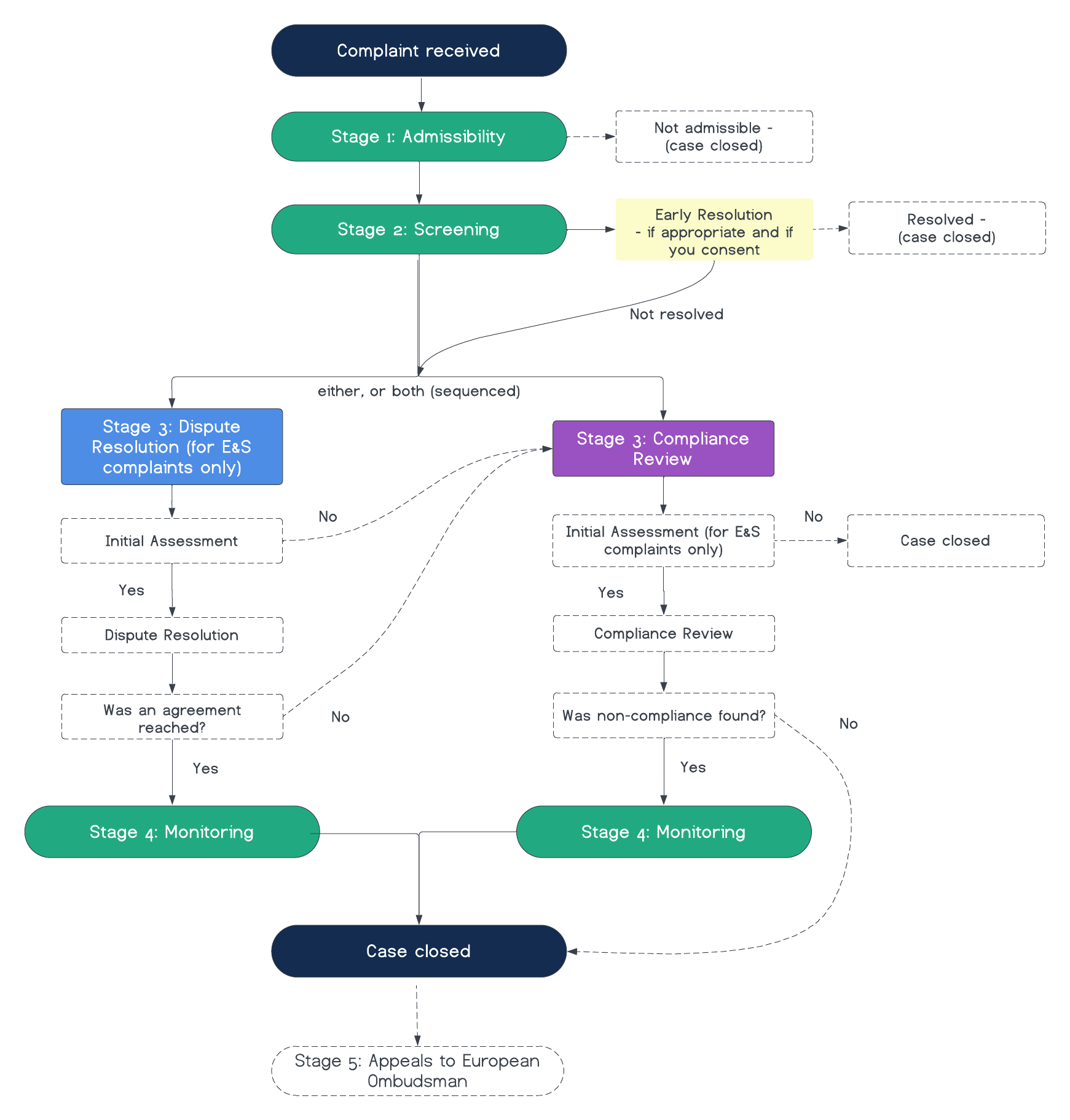
After filing your complaint, the EIB-CM will confirm that it has received your complaint (five working days). Within about two more weeks after that, it will tell you whether your complaint is “admissible” (meaning that it is eligible to continue in the complaint process).
Environmental and social complaints: To be admissible, a complaint about the environmental and social impacts of a project must:
- Project: relate to a project the EIB Group has financed or is considering financing.
- Harm: describe environmental or social harm that has happened or is likely to happen.
- Complainant(s): explain how you are affected, or, if you are a civil society organization, explain whether you are representing affected people or bringing the complaint independently. If you are bringing a complaint about social harm independently, explain why the directly affected people are unable to bring the complaint themselves (for example, fear of retaliation).
- Timing: complaints can be filed at any time while the EIB project is active. If the project is finished, the complaint must be filed within six months of the publication of the Environmental and Social Completion Sheet (ESCS). If there is no ESCS, you have up to 24 months after the EIB Group’s financing ends (for example, after the loan is fully repaid). If a project is under consideration for financing, but not yet approved, a complaint may be filed to the CM but it will be transferred to the relevant EIB project team for their response. The complaint is closed once they respond, but can be refiled if the EIB Group project is later approved.
Access to information complaints: To be admissible, a complaint about access to information must:
- Non-disclosure: describe how the EIB Group has failed to disclose or to provide access to information and documents; and
- Timing: be submitted within one year of when you could reasonably have known about the failure.
If your complaint is not admissible, the EIB-CM will close the complaint and explain why.
Within four weeks (20 working days) of the admissibility decision, the EIB-CM will decide which path your complaint will follow, taking your preference into account: early resolution, dispute resolution, or compliance review.
Early resolution is a new pathway where EIB Group staff will try to fix the problem directly with the project promoter (for environmental and social complaints) and with you (the policy says “where appropriate”). This is only possible if you and EIB staff agree to try it, the problem is clear and can be fixed quickly, there is no risk of reprisals, and the issues are not serious human rights violations (for environmental and social complaints) or wider, systemic problems. The early resolution process can last up to six months for environmental and social complaints, and up to two months for access to information complaints. The EIB-CM keeps your case open, and you can end early resolution at any time. The EIB-CM will ask you if you are interested in this pathway.
Because this pathway is new, we do not yet know its specific strengths or weaknesses. However, communities using similar processes at other banks have typically found early resolution processes more useful when they are addressing a few, straightforward concerns: such as obtaining project-related information, remedying impacts on a small number of people, or addressing a specific set of issues like construction practices, health and safety issues, or labor conditions. Some communities have appreciated the quicker timeframe to obtain an outcome. Other communities have been frustrated by a lack of transparency in the process (such as reports being prepared by the bank or client but not shared with communities), a lack of confidentiality (giving rise to safety concerns), and a lack of predictability about the process.
If early resolution isn’t appropriate for your situation or doesn't resolve your concerns, your complaint will then move to the next phase.
Please note that the process that follows differs for environmental and social complaints, and access to information complaints. Both are described below.
For environmental and social complaints, the substantive phases of the complaint process – dispute resolution and compliance review – each begin with an initial assessment. If your complaint goes through dispute resolution first and then moves to compliance review, there will be two initial assessments: one at the start of each process. Access to Information complaints are subject to a more streamlined process. There is no initial assessment. There is no dispute resolution pathway. If early resolution is not attempted or not successful, an access to information complaint proceeds directly to compliance review. For more information on each, see below.
A reminder: the process described below applies to complaints filed on or after 1 October 2026. We have archived our previous version of this guide, which explains how the EIB-CM handles complaints filed before 1 October 2026.
Dispute Resolution
Environmental & Social Complaints Only
Dispute resolution is a voluntary process where the EIB-CM helps you and the project promoter talk and find solutions together, usually with an independent facilitator or mediator. It is only available for environmental and social complaints.
Initial assessment: Before it can begin, the EIB-CM conducts an initial assessment to determine whether dispute resolution is appropriate for a particular complaint.
The initial assessment process usually takes about three months (60 working days). It involves reviewing project documentation, and gathering input from you, the EIB Group, and other relevant parties. The EIB-CM may conduct a site visit. For dispute resolution, it is specifically checking whether the parties are willing to participate and whether dialogue is likely to help. If the EIB-CM decides not to go ahead, you can ask for your complaint to move to compliance review assessment instead. If the EIB-CM decides that dispute resolution is appropriate, that phase will formally begin.
Dispute resolution: The EIB-CM explicitly describes dispute resolution as a pathway to provide remedy for complainants by delivering real improvements, building trust between the parties, and restoring dignity. It can include dialogue, sharing information, joint fact-finding, and mediation. This process should be designed and implemented together. EIB Group staff can join as a party or observer if everyone agrees.
Everyone takes part voluntarily and can leave at any time. If parties agree to participate, communities can share their concerns about the project directly with EIB’s client, and advocate for specific solutions to their concerns.
If there is no agreement after 18 months, the EIB-CM reviews whether to continue. In cases where it concludes that there is still a likelihood of reaching a resolution, it can extend the process in six month increments.
Outcome: If you reach an agreement, it is written down and signed. If you only partly agree, or don’t agree, the unresolved issues can move to compliance review assessment, if you agree to that transfer; otherwise the case is closed.
At the end, the EIB-CM shares a draft closure report with you for comments. The final report and agreement are published, unless confidentiality is required.
For more details on the dispute resolution process, refer to the EIB Group Complaints Mechanism Policy (2026).
Compliance Review
Compliance review is a fact-finding or investigation process where the EIB-CM assesses whether the project complied with EIB policies and whether it has contributed to harm.
Environmental and Social Complaints
Initial assessment: Before it begins, the EIB-CM conducts an initial assessment to determine whether a compliance review investigation is needed. This process usually takes about three months (60 working days). For environmental and social complaints, the EIB-CM is specifically checking whether there are early signs of harm, of rules not being followed, and of a link between the two. It will then publish a report explaining whether a full compliance review will go ahead.
Compliance review: If a full compliance review is conducted, the EIB-CM may visit the project site, hire independent experts and request information to determine whether harm has happened or could happen, whether the project and the EIB Group followed EIB Group policies, and what should be done. If it finds that the project has not complied with EIB policies and has contributed to harm, the EIB-CM can make recommendations to the EIB Group to address and remedy those issues.
After investigating, the EIB-CM will share a draft Compliance Conclusions Report with you, EIB staff and the project promoter at the same time (usually within about seven months of the initial assessment). You have about four weeks (20 working days) to comment on that draft. The report is then finalized and published.
Action plan: If the report finds issues that require a response, EIB Group staff must prepare a Services Response and Action Plan (SRAP) within about 10 weeks. It must say what will be done, who is responsible, how to prevent it happening again, and by when. It is agreed with the project promoter and must take your views into account. The EIB-CM shares the draft with you and checks whether it is adequate, in consultation with you.
If the plan is not adequate, or if EIB staff say no plan is needed, the SRAP will be elevated to senior leaders of EIB (the EIB’s Management Committee or the EIF’s Chief Executive/Deputy Chief Executive) who will be required to respond. The EIB-CM will also report on the disagreement to the EIB Group’s Boards (although it appears that the final decision on actions to be taken rests with EIB Management). All of these documents are published.
Access to Information Complaints
Compliance review is a fact-finding exercise where the EIB-CM investigates whether the EIB has complied with its access to information policies and procedures.
If it finds that the EIB has not complied with its access to information policies and procedures, the EIB-CM can make recommendations to the EIB Group to address and prevent those issues from recurring.
After investigating, the EIB-CM will share a draft Compliance Conclusions Report with you and EIB staff at the same time (usually within about three months of the admissibility decision/transfer from early resolution). You have about four weeks (20 working days) to comment on that draft. The report is then finalized and published.
If the Conclusions Report contains recommendations, the EIB will be required to be transparent about any recommendations that they are not planning to implement.
If there are any recommendations that the EIB does not plan to implement, the EIB-CM will elevate those issues to senior leaders of EIB (the EIB’s Management Committee or the EIF’s Chief Executive/Deputy Chief Executive) who will be required to respond. The EIB-CM will also report on the disagreement to the EIB Group’s Boards (although it appears that the final decision on actions to be taken rests with EIB Management). All of these documents are published.
For more details on the compliance review process for environmental and social or access to information complaints, refer to the EIB Group Complaints Mechanism Policy (2026).
If your complaint goes through a dispute resolution process and results in an agreement, or identifies non-compliance during a compliance review, then the complaint will enter a monitoring phase.
Dispute Resolution
Environmental and social complaints only: If you reach an agreement, the EIB-CM will monitor the implementation of that agreement, unless the parties agree that no monitoring is required.
The nature and frequency of monitoring will depend on the circumstances of each agreement, but in general the EIB-CM will regularly engage with the parties, at least every six months, and may conduct site visits to check on the progress of implementation. The EIB-CM will publish interim monitoring reports on its website (where appropriate) and a final monitoring report after completion of the monitoring period. The EIB-CM will submit draft monitoring reports to the Parties for comments before it finalizes those reports.
The monitoring period will depend on the terms of the agreement, but in general will last for no more than 18 months following the date of the agreement. In “justified” cases, the EIB-CM may decide to extend this monitoring period.
Compliance Review
The EIB-CM checks progress on the action plan (for environmental and social complaints, or its recommendations (for access to information complaints) every six months.
Monitoring may include the EIB-CM conducting site visits, meeting with you, and/or hiring independent experts to verify that commitments are being implemented. Results are published and reported to the EIB Group’s Boards, which can ask EIB staff to take steps to fully implement the action plan.
The monitoring period will depend on the implementation timelines set out in the Action Plan. In “justified” cases, the monitoring may be extended beyond those timelines if the EIB-CM believes that there is progress that can still be made.
The EIB-CM process is unique in that, if you are dissatisfied with the handling or outcome of your complaint, you can appeal to the European Ombudsman. The appeals process is available only to European Union citizens, or people or organizations living or registered in a Member State. If you do not meet these qualifications, your appeal will need to be supported by a person or organisation that does.
If you are not satisfied with the outcome of your complaint, or with how the EIB Group responded to it, you can complain to the European Ombudsman about “maladministration” by the EIB Group. The EIB-CM will tell you about this option in its final reply. Complaints must be filed within two years of receiving that final reply.
You can also go directly to the European Ombudsman with complaints about poor administration that the EIB-CM does not handle.
The Ombudsman can recommend actions for the EIB Group to take if it finds maladministration, but these recommendations are not legally binding.
Comparison to best practice
Independence: The EIB-CM’s independence is partially protected. The EIB-CM’s line manager is the Group Chief Ethics and Accountability Officer, not the Board. The Policy describes this office as “operationally independent” from EIB Group staff, the EIB-CM still does not report directly to the EIB Group Boards (the preferred reporting line for a function of this nature).
Independence: That said, the EIB-CM’s independence has been protected in some important ways: the Group Chief does not decide whether or not an investigation takes place (a change from the 2018 rules); and the EIB-CM can report directly to the Board if there are concerns around the adequacy of an action plan developed following compliance review.
Transparency: The EIB-CM makes complaints, eligibility reports, final compliance reports, dispute resolution reports, and monitoring reports public, although it will withhold such documents if there are privacy or confidentiality concerns.
Remedy: Under its 2026 Policy, the EIB-CM explicitly has a role to facilitate remedy through its dispute resolution pathway and by recommending that remedial action is included in action plans following a compliance review.
A look at the data
We have brought together some charts, based on the latest data available in the Complaint Dashboard, to offer a deep dive into the EIB and EIB-CM’s performance. Please note that currently this data reflects complaints made before 1 October 2026, when the EIB-CM received a broader range of complaints about “maladministration”. As it is updated, it will also reflect complaints after that date, when its scope was narrowed.
Complaint Outcomes
Eligibility
Dispute Resolution Outcomes (when undertaken)
Compliance Review Findings (when undertaken)
Complaint issues
Complaint sectors
Recommendations to improve the EIB-CM
EIB-CM should expressly reinstate the availability of concurrent compliance investigation and dispute resolution for efficient and holistic delivery of remedy. (GPP 38)
The EIB Group Boards should exercise greater oversight over the delivery of remedy by ensuring that Actions Plans address all of the EIB-CM recommendations, developed in consultation with complainants. (GPP 54 and 56)
Complaints should be admissible even if parallel proceedings have been brought against a member of the EIB Group before other administrative or judicial review mechanisms. (GPP 34)
EIB Complaint Mechanism (EIB-CM): https://www.eib.org/en/about/accountability/complaints/submit/index
To send complaints:
complaints@eib.orgOnline complaint form:
https://www.eib.org/en/forms/complaints-formEuropean Investment Bank
Complaints Mechanism Division
98-100, Boulevard Konrad Adenauer
L-2950 Luxembourg
Date Last Updated: Nov. 2, 2026